
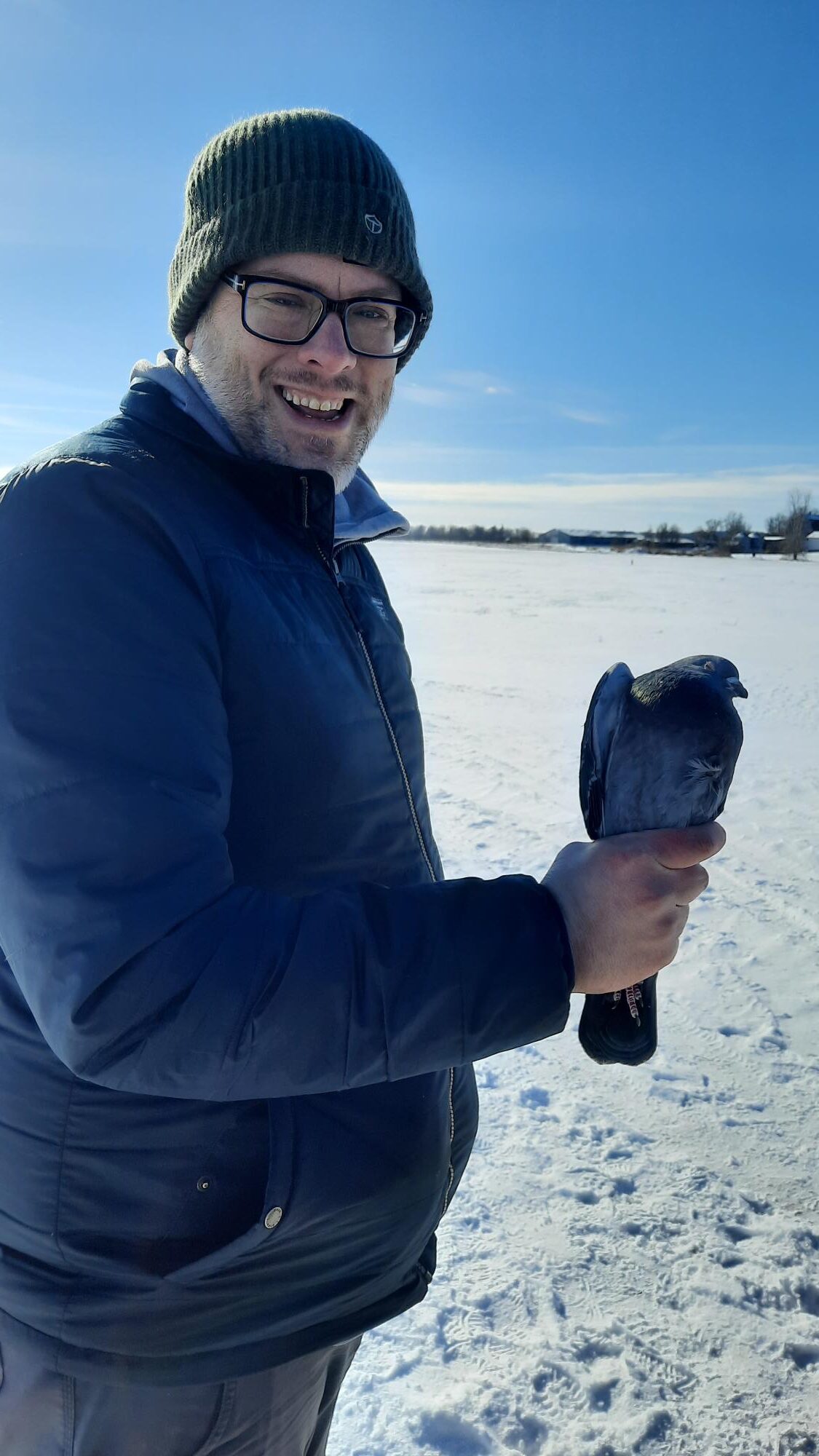
I’ve been hearing about this impending storm all week – a massive snowfall over a huge area of the U.S. and Canada. Yesterday, the birds didn’t seem overly concerned. I expected there to be a heavy concentration of buntings and larks wanting to feed to put on some fat as insulation against the storm. And when the morning temperature started off at -22 C.(-28 with the windchill) I thought for sure the traps would be busy. But it just wasn’t the case. At one point there was a mixed flock of ~75 birds but they were pretty skittish and many didn’t stick around; catch numbers were fairly modest. Maybe the main reason was that our pair of American Kestrels was around, sitting in the top of tree about 150 m. away. The one advantage of this relaxed capture rate was that the group of keen students from the U. of Guelph that Sarah brought were able to handle a good number of the Snow Buntings – it was a good “learning rate”.

We ended up banding 27 Snow Buntings and 1 American Tree Sparrow. The sparrow was interesting. This is not a bird that frequents wide-open, barren fields but there it was. I think it likely worked it’s foraging way along the sparse shrub line on the other side of Stoney Creek Road and when it saw all the action at the traps decided to take a look – and didn’t take long to get a good feed. Upon release it made for the shrub line…wiser and maybe fatter.
The birds were not really “attacking” the traps/corn. Quite often a group of about 20 would sit within 30 m. of the traps and just watch. But when we decided to pack it in, it was a different story. 50-60 birds were immediately on the bait piles.
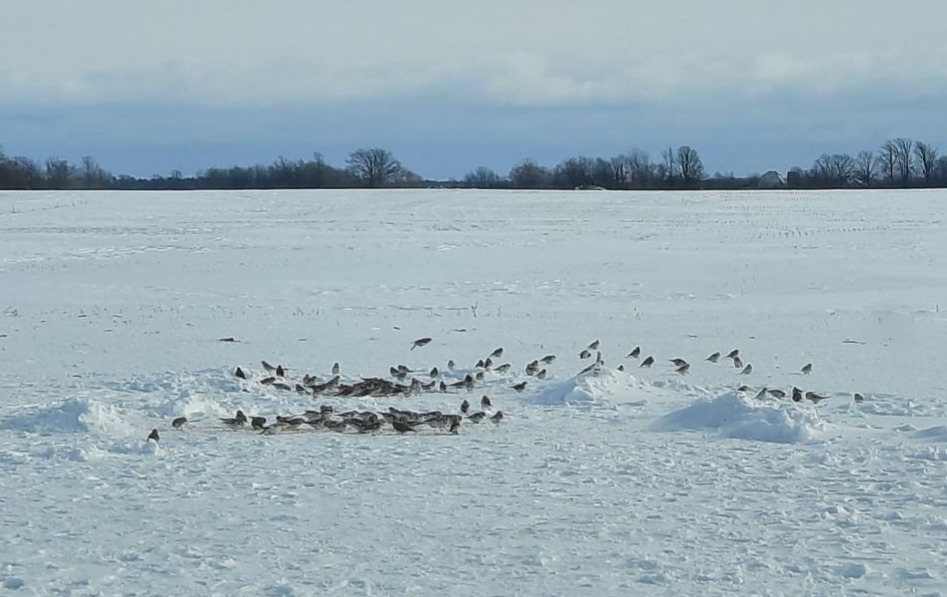
But this morning it was a different story. My various weather apps suggested there might be a window of opportunity early; the snow wasn’t going to start in earnest until around 8 AM. I arrived at 7:15 as a gray light was just beginning to ooze over the field. But I could see things had changed: there was a mixed flock of 75 Snow Buntings and Horned Larks sitting on the remains of yesterday’s bait piles. They were looking to feed. I knew snow was coming – in fact, a fine snow was already falling – so I put out only 3 traps. Before I even got back to the car they were, literally, already in the traps and attacking the corn. At 7:30 I took 26 birds out of the traps: 19 “new” ones and 7 retraps. On my next (and last) pass I removed another 34: 32 “newbies” and 2 retraps. By this time the snow was falling thickly and the brisk wind was piling it up inside the traps – in fact, the birds inside would not have been able to get out as the tunnels were almost filled in. It was clear that these birds weren’t fooling around; they wanted to take in as much food as possible so they could sit out the storm safely. I ended up banding 42 Snow Buntings and 9 Horned Larks.
When I’m using mist nets I calculate the rate of capture in terms of the number of birds per 100 net hours; i.e., if a single net was open for 100 hours, how many birds would I catch on that day. I make a similar calculation for traps: # of birds per 100 trap hours with 1 trap hour being a trap in use for one hour. This morning I used 3 traps and had them open and catching for an hour and 10 minutes (1.17 hours). Thus the number of trap hours would be: the # of traps (3) X the length of time they were open (1.17 hrs). This works out to 3.51 total trap hours. I caught 60 birds so the rate of capture was a staggering 1,709 birds per 100 trap hours. [# of birds divided by the total trap hrs x 100]. For comparison, yesterday’s rate of capture was 152 birds per 100 trap hours.
Rick
A good season for snow buntings!