
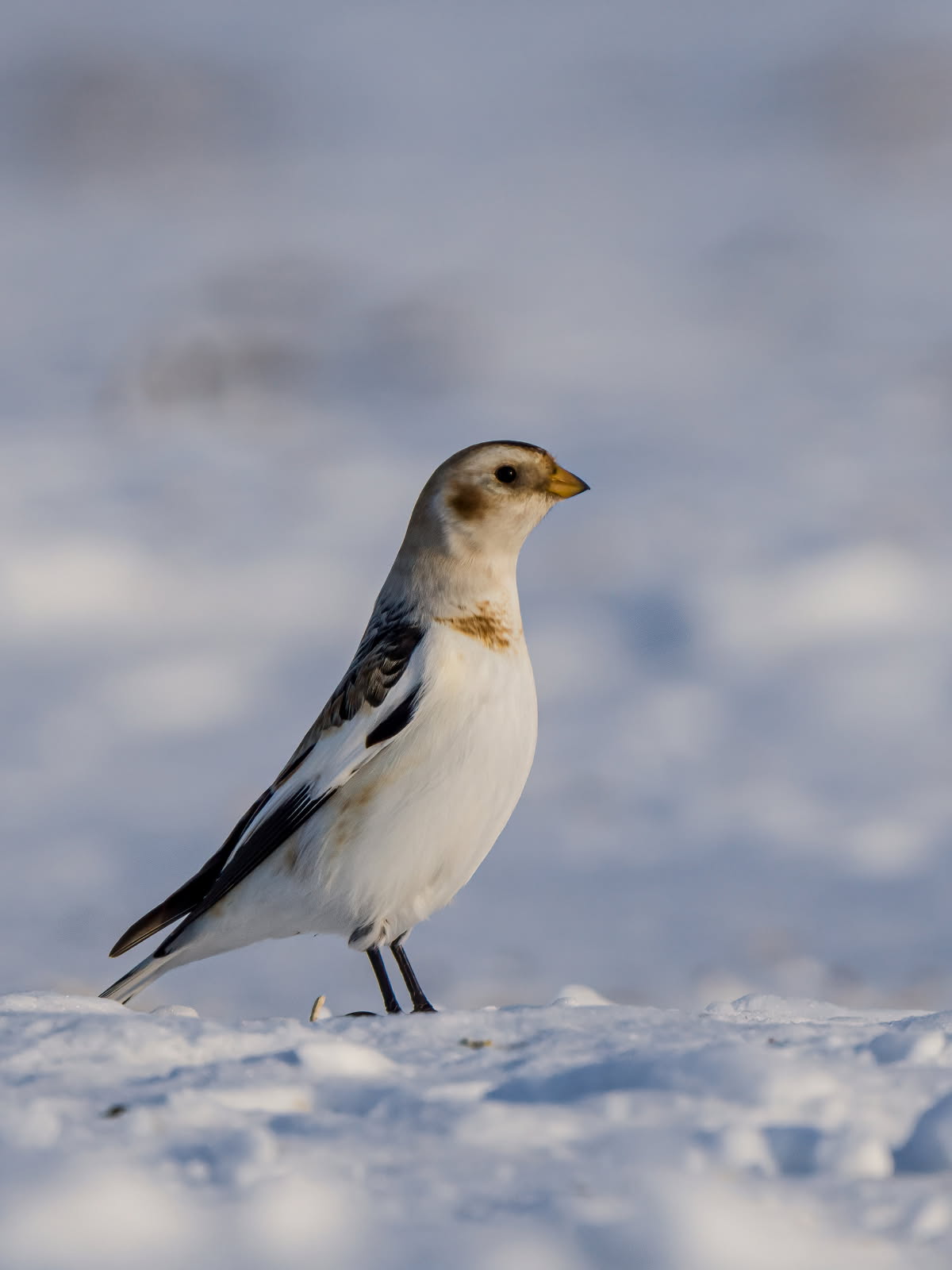
After the start yesterday morning – a frenetic feeding frenzy by Snow Buntings preparing for a blizzard – one would have thought that this morning would have been an ideal bunting banding time – lots of new snow and cold temperatures. I got out early, dug my way onto the gravel parking pad, set out the traps, laid down cut corn, and waited….and waited…..and waited. Finally a small flock of ~25 Horned Larks flew in to the area but just sat. Every now and then a few would investigate the traps and scavenge any corn left outside them, then fly back to their observation posts. I waited until 10:30 before deciding I could be doing better things. I wasn’t completely skunked: I banded 1 Horned Lark, 1 (errant) Snow Bunting (one of only two seen) and retrapped 5 Horned Larks. Where were all the Snow Buntings from yesterday!?
Well, they might have roamed as far as Marnie’s place on Irish Line which is about 12 km away as the bunting flies. She reported a sizeable flock and, with only 2 traps, ended up banding 68. This would be in keeping with what we’re learning about their wintering behaviour. Horned Larks seem to be more circumscribed in their winter search for food, staying in a particular area, especially if there’s a fairly reliable food source. Snow Buntings, on the other hand, roam over a wide distance with a winter range that might be as large as 1400 square kilometers. So once the food I had laid out was consumed or was covered by snow they likely would have headed off looking for other sources, not confident that I would return with more.
Around 3:00 in the afternoon I returned to my York Airport site to touch up the bait piles in readiness for tomorrow and simply to see if there was anything around. I wasn’t expecting much. Upon arrival I couldn’t see ANY birds at all. After returning to my car, within 2 minutes a flock of at least 125 Snow Buntings descended on the corn. Where did they come from!? More importantly, how did they know that my actions would result in the laying out of high energy food. My guess is that after I left in the morning they chanced upon feeding larks (and my 7 Rock Pigeons) and joined in until it was almost all gone. Then they had sat out in a relatively sheltered spot to digest and watch the goings on in the field, looking for more feeding behaviour by other birds. They have tremendous spatial memory and when they saw some action in the very spot they had previously been feeding in they flew over to take a look.
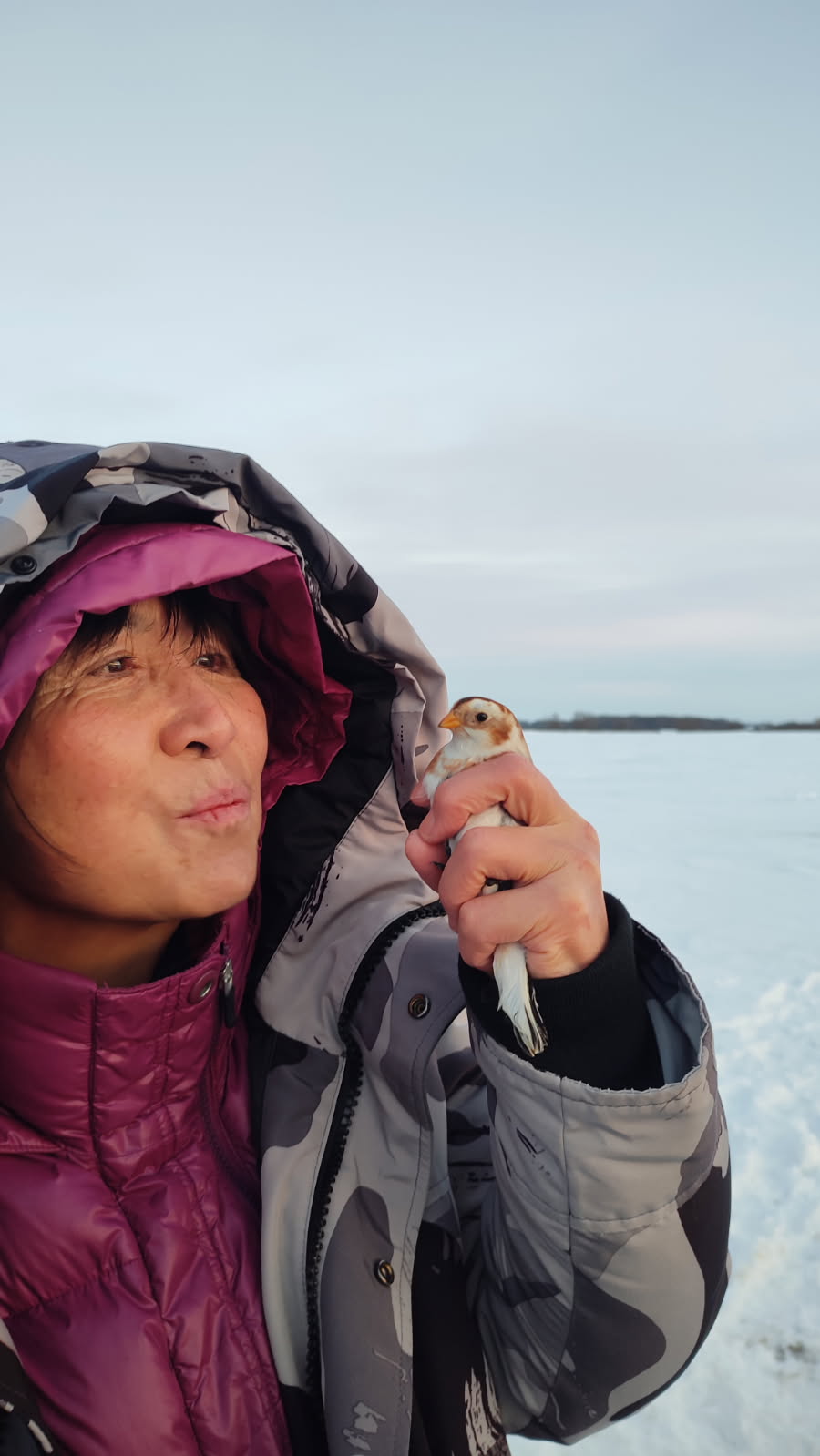
I quickly put out 3 traps and called Marg who dropped off my banding kit (I had not been expecting to band). It didn’t take them long to find out how to get at the corn and in the space of an hour I had caught and banded 37, finishing off the last few as dusk settled in. I wonder where they will be tomorrow….

I was joined by two old photographer friends, Jia and Dale, who often make the trek down from Oakville to take advantage of good conditions: we had blue skies, white snow, and the beautiful golden colour when the sun dips toward the horizon.
There’s an interesting difference emerging between the York Airport and Irish Line sites: the ratio of females to males. Usually, they are fairly similar at about 2.5 females to 1 male. Females tend to spend the Winter further south than males where the conditions are bit less harsh. But right now, the ratio at the airport (based on 326 banded birds) is only 1.38 females to every male. While on Irish Line Marnie is getting (based on 201 birds) 2.47 females to every male.
Rick